


As Josh and I have been working through our thesis, we’ve settled on a working title for the book: Between the Whip and the Cheek: Holy Love Navigating the Sacred and the Profane. In this post, I want to connect my previous discussion of myth with the categories of the sacred and the profane—that is, to connect creation myth and mythos more generally with religion and religious thought. Religious thought is impossible without a distinction between the sacred and the profane, and that distinction cannot be sustained without a creation myth. Christianity claims not only to preserve this distinction but to fulfill it through holy love, revealing judgment (the whip) and self-giving vulnerability (the cheek) as expressions of the same divine reality.
If this claim is correct, then the question immediately becomes whether such distinctions are uniquely Christian—or whether they are universal features of human experience.
Christian philosopher Norman Geisler once argued that what is demonstrable from both believer and nonbeliever alike is that humankind, as a whole, is incurably religious.1 Despite this, claims about the diminishing—or even disappearance—of religion remain common. Is there anything more cringey than the phrase “I’m spiritual but not religious”?Do people still say cringey? Perhaps less cringe-inducing, but no less misguided, is the claim that one has no religious inclination at all.
But if religion really is universal, then we need to be clear about what we mean by the word—otherwise we risk mistaking denial for absence.
When I ask people to define religion, they usually point to belief in a supernatural being. I often respond by asking, So is Buddhism not a religion? Buddha himself did not consider belief in God a central—or even necessary—question, and practicing Buddhists will readily affirm that a range of metaphysical views can exist within their tradition. In pressing this question, I often find myself answering my own: perhaps religion is better understood not first as belief in a god, but as a belief system.
That clarification helps, but it also raises an important distinction. Not all belief systems are religions, but any belief system can become religious if it is elevated from a penultimate framework to an ultimate concern—one that governs a person’s interpretation of reality as a whole.
For example, a philosophy of education is ordinarily just that: a belief system. But if education becomes the primary means of human salvation and progress—if hope and meaning are located there—then it has taken on a religious character. If one believes that humanity’s moral failures can be overcome primarily through the eradication of ignorance, then education has become salvific. If one believes that reality itself is ultimately defined and mediated through education, then it has become religious. Framed this way, we come closer to what is actually at stake.
Paul Tillich’s well-known definition sharpens the point further. He defines religion as humanity’s ultimate concern. This formulation widens the lens considerably, capturing phenomena that narrower definitions miss. In this sense, the original Humanist Manifesto was correct—and refreshingly honest—in explicitly identifying secular humanism as a religion. It offered a naturalistic account of ultimate reality—a creation myth—along with a vision of salvation grounded in education, moral progress, and social reconstruction apart from divine intervention.
Up to this point, I have been making a largely descriptive claim. Let me now state it explicitly by formalizing the argument for clarity:
Premise 1: Everyone has an ultimate concern—an orienting center of value (that is, everyone is religious in some sense).
Premise 2: Every ultimate concern is expressed and sustained through a mythic framework—a creation myth and its ensuing mythos.
Therefore: Everyone lives by a creation myth and its accompanying mythos, whether acknowledged or not.
Both premises deserve careful defense, and I intend to return to each in later posts. For now, I ask the reader to consider them provisionally—not as settled conclusions, but as claims that make sense of the world we already inhabit. We behave as though ultimate concerns are unavoidable, and we sustain them not through abstraction alone, but through stories about where we came from, what went wrong, and what ought to be hoped for. If that is even approximately true, then the implications for how we understand religion, morality, and the sacred are difficult to avoid.
Émile Durkheim defined religion as a unified system of beliefs and practices relative to sacred things—that is, things set apart and forbidden. These beliefs, he argued, unite adherents into a single moral community, which he called a Church, though it need not be organized around a literal church building. For Durkheim, the classification of reality into two opposed categories—the sacred and the profane—is the common characteristic of all known religious beliefs.2 The first religious belief, therefore, is a creation myth.
Mircea Eliade deepens this account by describing religious thought as an “ontological thirst.” For religious humanity, the sacred is equivalent to power and, ultimately, to reality itself. The sacred is saturated with being, while the profane is associated with chaos, illusion, and non-being. Religion, then, is the attempt to live as much as possible within the sacred in order to avoid the terror of nothingness.3 The first means of resisting this chaos is order—and order is established through a creation myth.
It may seem intuitive that people are inherently religious—perhaps even a brute fact—but resistance is often strongest when it comes to the claim that scientifically minded people live by a creation myth. People may deny living by a creation myth, but they cannot escape living from one. As I have argued elsewhere, myth does not mean false, and the same is true of creation myth. The Leemings’ definition is particularly helpful here because it cannot be confined to traditionally religious thought:
A creation myth is a cosmogony, a narrative that describes the original ordering of the universe. The word cosmogony is derived from the Greek kosmos, meaning order, and genesis, meaning birth. A given culture’s cosmogony describes how order and existence were established. Just as individuals and families are preoccupied with their origins, cultures need to know where they and the world they inhabit came from. For this reason, virtually all cultures have creation myths.4
Is the scientist unconcerned with ultimate origins? Of course not. Everyone is.
If everyone lives by a creation myth, the next question is what these myths actually do. Creation myths are often misunderstood as primitive attempts at science—early guesses about how the universe came to be. But their primary function has never been explanatory in that sense. They are not chiefly concerned with mechanics or chronology. They are concerned with meaning, value, and order. They tell a people what reality is, what it is for, and where humans stand within it.
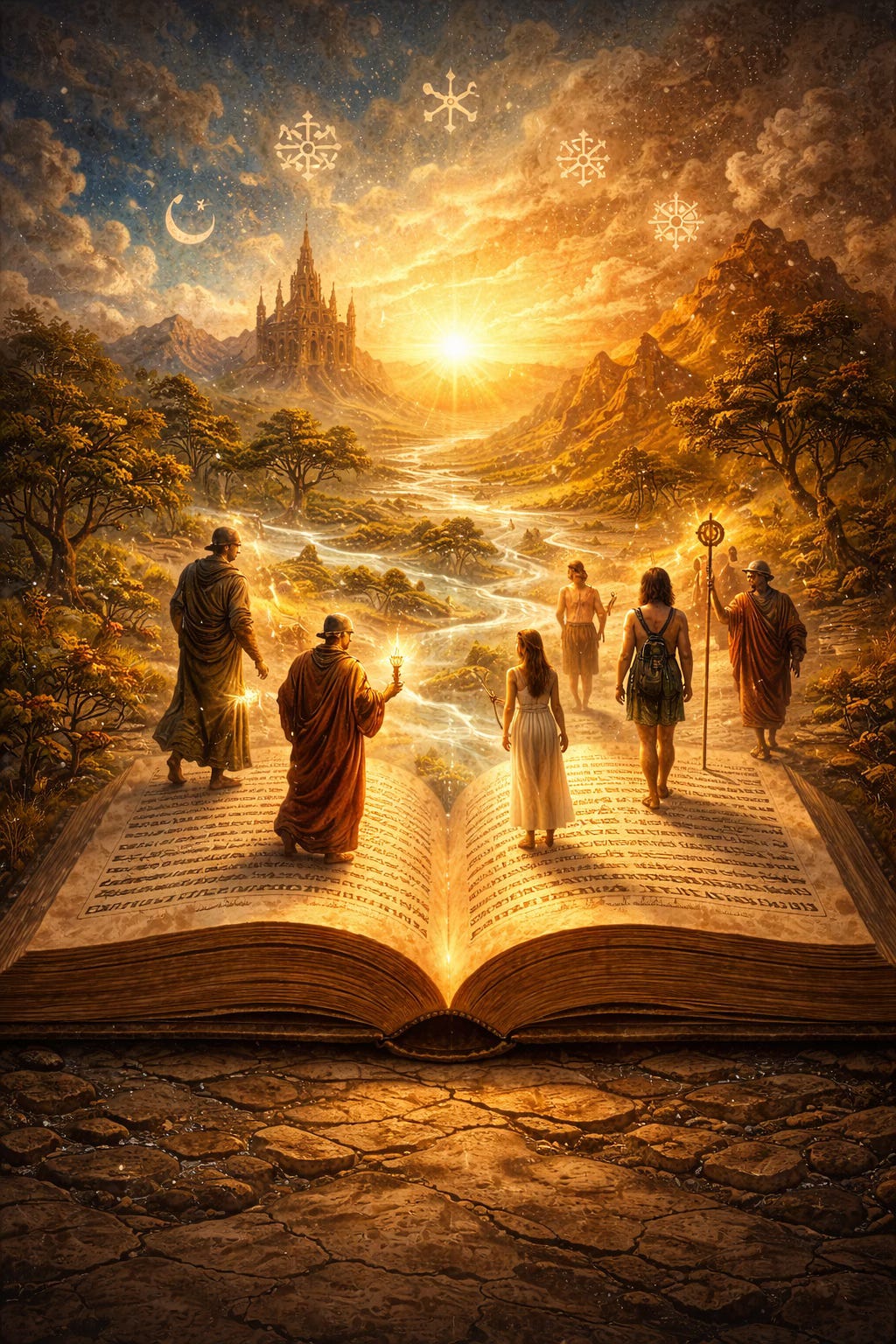
More importantly, creation myths establish weight. They assign significance to certain realities and place limits on how those realities may be treated. In doing so, they generate the most fundamental religious distinction of all: the distinction between the sacred and the profane. What is sacred is that which bears weight—what cannot be used, violated, or treated as ordinary. What is profane is not evil, but common: that which may be handled, shaped, or expended without moral consequence. Every creation myth, whether ancient or modern, religious or secular, performs this work. It tells us what must be reverenced, what may be used, and what constitutes desecration. Without such a story, the distinction collapses, and with it any coherent account of holiness, morality, or love.
If all people live by a creation myth, if all people are incurably religious, and if all religious thought is structured by the distinction between the sacred and the profane, then the real question is not whether one has a myth or a religion, but whether one’s myth—and the sacred order it establishes—can bear the moral weight we inevitably place upon it and satisfy our “ontological thirst.” Our thesis is that Christianity alone, through the holy love of Jesus Christ, is capable of carrying this weight.
Geisler, Norman L. Philosophy of Religion. Baker Academic, 2003. 26
Goody, Jack. “Religion and Ritual: The Definitional Problem.” The British Journal of Sociology, vol. 12, no. 2, 1961, pp. 142–164.
Eliade, Mircea. The Sacred and the Profane: The Nature of Religion. Translated by Willard R. Trask. Harcourt, Brace & World, 1963. 13
Leeming, David, and Margaret Leeming. A Dictionary of Creation Myths. Oxford University Press, 1994. viia
Awesome post. I need to up my game!